

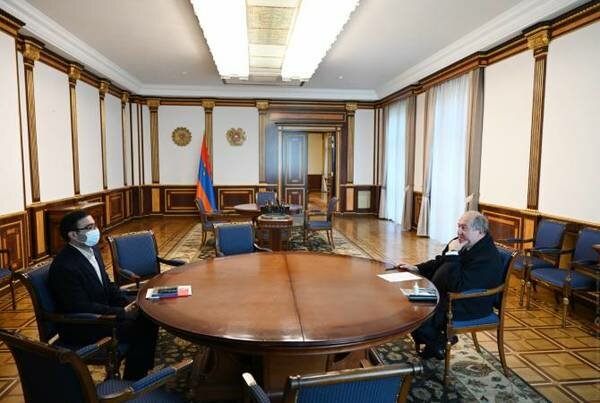
According to Ziabari, tensions between Armenia and Azerbaijan have been a mainstay of world news. Most journalists who talk to the leaders of the two countries start their conversations by directing vexed questions about why conflict over the Nagorno-Karabakh enclave has dragged on for so long and what the future holds for relations between two neighbors whose differences seem unbridgeable.
But Armenia is not all about its skirmishes with Azerbaijan. The first world country to officially adopt Christianity as a state religion in 301 AD, Armenia is the wellspring of an ancient civilization and has fared notably well in cementing its democratic credentials. It scores better than Singapore and Malaysia in the Freedom House’s rating of political rights, and has made tangible strides in combating corruption.
Kourosh Ziabari: If history is indeed on your side, why hasn’t the Armenian government been able to draw the support of the international community and the UN Security Council that consider Nagorno-Karabakh as Azerbaijani territory, as reflected in UNSC resolutions 822, 853, 874 and 884?
Armen Sarkissian: What is interesting, I think, is that you’re not the first person nor the last one who would like to build the international relations on historic justice. But it doesn’t work like that in the real world. Am, I right?
Ziabari: Sure!
Sarkissian: I think historic justice is one of the components but the real world is the real world. Indeed, I think if you have the chance of traveling to the territories of Artsakh, Nagorno-Karabakh, it would be a fantastic trip, because you go through all of the different ages of our history. That area was always inhabited by ethnic Armenians. If you go back, you’ll find Armenian churches coming from the fourth or fifth century and so on.
I was recently on a state visit to Italy. As part of that visit, I visited the University of Bologna and had a very interesting tour to the library where they presented us some of their old Armenian manuscripts they had. There was a very interesting material which was an old 16th or early 17th-century map depicting Armenian cultural and religious centers.
Those who have founded and made it were in fact based in two places: in Jerusalem and in Constantinople. The map covers current Turkey, it covers current Armenia, it covers partially places in Iran up to Isfahan and other places. But it also covers Nagorno-Karabakh with hundreds of Armenian medieval churches and cultural centers there. So, this is about history.
Secondly, I think, unfortunately the history is pretty simple! That territory was rich of invasions, fights, relations with the Persian Empire, and you can find a lot of culture there, as well. But if you go back around 200 years ago, you’ll see that territory was taken over by the Russian Empire from the Persian Empire.
And then comrade Stalin, who was the great designer of borders and in reality, a great creator of problems between nations, including between Armenia and Azerbaijan, at that time gave Karabakh and Nakhchivan to Azerbaijan, because Soviets wanted to help create a common border between Azerbaijan and Turkey, and because Turkish leader Atatürk was seen as a great friend of Bolshevik Russia.
This is not about historic justice; this is about a desire for political manipulation and relations. And in more than 70 years of the Soviet rule, people of Nagorno-Karabakh at that time, Artsakh, were never happy living under Azerbaijan for many reasons.
And with the end of the Soviet Empire in 1985, when Gorbachev introduced changes, the emotional Armenian people, especially in Nagorno-Karabakh, believed in what was declared by Gorbachev: freedom of speech, Perestroika, redesigning, and so on, and then a movement started for the independence of Nagorno-Karabakh triggering Soviet Azerbaijan’s military operations and violence against ethnic Armenians living in Nagorno-Karabakh which turned into a full-fledged war that the Armenian side won. And then for last 26 years, Karabakh and attached territories were under the control of the Republic of Artsakh or Nagorno-Karabakh until the war of 2020.
Now, why the international community didn’t do this or didn’t do that? Well, the international community was involved; international community has decided that the organization that should be responsible for the future status of Nagorno-Karabakh is the Organization for Security and Cooperation in Europe (OSCE), not the United Nations, not the European Union.
And that organization has created a specific group, which is the Minsk Group, and the three co-chairs of this group were the United States, France and Russia, representing the interested parties, namely the United States as a superpower of the time, the European Union represented by France, and Russia. And basically, the sides were negotiating a possible solution with all its details.
So, there was an international institution that was in charge and I hope that we will go back to negotiations and we don’t have to recreate or create a new format or framework, because it already exits and has a history.
Unfortunately, the second war in 2020 has destroyed the process of negotiations, but I think the best solution that we can get today is to engage the same organization. Now why did we win the first war, but lost the second one?
Let’s speak about the first war. Azerbaijan was, at that time, supported by Turkey. But Turkey was different under President Demirel, Prime Minister Tansu Çiller and others. And Armenians, and Karabakh probably were different. To make it simpler, I would say that we were a bit ahead of Azerbaijan; we were ahead of designing construction of army; we were ahead of motivation, war, discipline and science.
There were generals, colonels, captains or soldiers who were serving in the Soviet army and had the experience of the Afghanistan War. So, the experienced soldiers were coming to a voluntary army, the army of Fedayeens or voluntary people creating an army. And we were a bit quicker than Azerbaijan. Unfortunately, during the past 26 years we didn’t manage to convert the victory into stable peace.
Why I’m saying we couldn’t manage? Because it’s always not one side. At least, there are two or several sides. But because we were victorious, I think we had the upper hand to be more proactive and quickly convert the victory into stable peace. And probably towards the end of 1990s and beginning of 2000s, there was a chance of doing that and I will explain to you why. That was the time that Azerbaijan was trying to build the pipeline from the Caspian Sea to the European markets, to the Mediterranean, to Turkey – Ceyhan.
President Heydar Aliyev was a very pragmatic person. I didn’t have that discussion with him but I have met him several times, and his son more later – but I can guess that in his list of priorities, the pipeline was of the higher significance. Without the pipeline, there was no chance that Azerbaijan would ever get back Karabakh, because the pipeline was power, money – money that helped them to rebuild their own army; and then it was also money that helped them to build their public relations and relations with other states including Europe.
For him it was a priority and at that time the Armenian army was the most powerful in the region. And that was the time that probably we should have gone into deep negotiations and sort it out. After that, the history started going 180 degrees in the other direction; Azerbaijan was becoming more powerful and Armenia was basically and gradually sort of falling behind the development.
The Armenian side was still enjoying the victories and believing that the issue was resolved and that the Minsk Group of co-chairs had a final conclusion. But the negotiations were not very successful, the sides were emotional while there were elections here and there, so these negotiations were being shaped in a different form.
Ziabari: I want to make a quick reference to Armenia’s present challenges with Azerbaijan. There was a massive rally in Yerevan in December last year, the March of Dignity, after the Russian-brokered armistice was signed, and many Armenians, mostly from the opposition party Homeland, were expressing frustration over the terms of the peace deal believing that the government didn’t act prudently and acquiesced to a ceasefire that took away from Armenia territories it had controlled for more than a quarter of a century.
Do you believe Armenians are right to be disgruntled? Do you personally find the terms of the peace deal favorable or think the government could have negotiated more persuasively?
Sarkissian: It takes me back to our Constitution. I’m the president of the parliamentary Republic and not in the position to comment on what I think about the parliament or the government.
As a president, I have very limited tools which are defined by the constitution. When something comes to my table, I have only two options; either to sign it or send it to the Constitutional Court.
Not every law that is on my table is anti-constitutional, but it can be anti-state, anti-education, anti-culture. The constitution is less effective until we don’t change it. And I made it clear that if we go on with the constitutional changes, I’m ready to resign.
Secondly, psychologically, for most of Armenians it is difficult to get the concept of parliamentary democracy. Probably it’s difficult for them to understand why the president cannot sack a minister.
Thirdly, our constitution was written at the time of the third president who was hoping to become the next prime minister. So, there were no checks and balances. If you have a constitution without checks and balances, then you will have very big problems. Any democracy, be that presidential or parliamentary, has to have checks and balances.
And the president doesn’t have enough power to stop any law or to balance the government or prime minister’s power. And that’s not healthy. What I’m pushing now is the change of constitution. And it doesn’t matter if it changes to presidential one or will change kind of by bringing more checks and some balances, but we need a change.
Now, there is a statement on ceasefire and further steps by le...
Read full story


