

Armenpress presents the full article:
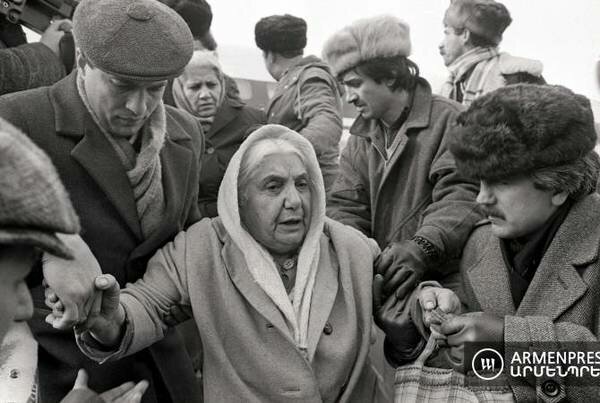
“This January marks the 30th anniversary of the tragedy when the last Armenians were forced to flee Baku, the capital of Azerbaijan, due to the ongoing Azerbaijani pogroms. In other areas of Azerbaijan there were no Armenians left, even though they had lived there for hundreds of years.
During the pogroms, units of the Soviet Army with tanks and other heavy weapons entered into Baku, the million-city. They entered late, when the pogroms were in full swing.
The army was opposed by Azerbaijani activists, many of whom had attacked or even killed Armenians, plundering and destroying their property. The future mayor of Vilnius, Artūras Zuokas, then a budding journalist, visited Baku on January 24-31, 1990 and wrote about Armenian suffering in the newspaper of the Vilnius University: "People were being thrown out of the windows, burned and beaten to death”.
This testimony is even more valuable considering the fact that Zuokas condemns the entry of troops. In his view, the rescue of the Armenians was a pretext for the main purpose of suppressing the Azerbaijani national movement led by the Azerbaijani People's Front. (See: A. Zuokas. What do tanks defend on the streets of Baku? // Universitas Vilnensis February 9, 1990). The biggest clashes with the army took place on the streets of Baku on 19 and 20 of January. It is on 20th January that present-day Azerbaijan annually commemorates a Day of Mourning.
The commemoration is being organized by the authorities, and this year the President of Azerbaijan, Ilham Aliyev, addressed the citizens urging them to participate in as many events as possible, during which they will, as usual, curse and threaten Armenia and Armenians.
In Lithuania, we will probably see articles or comments in the press and on the Internet, in which, like many times before, the 1990 January events in Baku and 1991 events in Vilnius will be compared. In both cases there were fatalities and injuries due to the actions of the Soviet Army. By the way, in Baku far more than in Vilnius. There, in Baku, soldiers and officers were killed and injured as well. However, this difference is not an argument for denying the similarity of the events in Baku and Vilnius. What is important, is what had happened in Lithuania and Azerbaijan until those events. And, of course, it is also important, how these events are explained now, and which of the moments are being highlighted.
In Lithuania, as it is well known, Sąjūdis did not proclaim hatred towards people of other nationalities living in Lithuania, and there was no violence against the foreigners. The Republic of Lithuania, which declared independence on 11th March in 1990, recognized all the people residing in its territory as citizens of the State, regardless of their nationality.
In January 1991, there were no conflicts or battles between people due to national hostility. The violence of the Soviet internal army was opposed by peaceful rallies attended by thousands upon thousands of people from all over Lithuania.
During the night of January 12 to 13, the military shot 13 unarmed people, several hundreds were injured or had otherwise suffered. In the face of nonviolent resistance, USSR leaders did not dare to resort to the widespread use of force, thus soldiers were returned to the barracks.
The events of 13th January in Lithuania are regarded as sad and at the same time honorable anniversary, and it is never wasted with accusations and threats against people of other nationalities living in Lithuania. Meanwhile, Azerbaijan's path to state-building in the Soviet Union was accompanied by Armenian pogroms, massacres and expulsion. It is the totality of these actions that is called ethnic cleansing.
It is true, that the ethnic cleansing began yet in the distant Soviet years, when the so-called Nakhichevan Autonomous Soviet Socialist Republic was incorporated into Azerbaijan. The population was made up half of Armenians, and the Baku authorities by any means urged or forced them to leave for Armenia or other parts of the USSR.
It is clear that for the Azerbaijani authorities it was no longer possible to kill Armenians in Soviet times, as they did together with Turkish army after the 1917 Revolution in the Caucasus. However, displacement without bloodshed was long, but proved to be effective. In 1989 there were no Armenians left in the territory of Nakhichevan ASSR.
In the rest of Azerbaijan, the Nagorno-Karabakh Autonomous Region, the Armenian population made up over 90%, and the Azerbaijani authorities were not successful in eliminating them. Instead, the...
Read full story


